

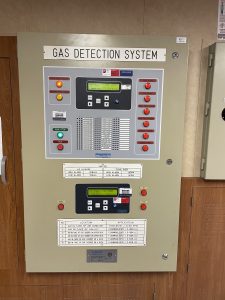
Fixed gas detection channels are tested onboard.
With the Panasia GDS-3000 and professional onboard service you stay compliant, protected, and operational.
The Panasia GDS-3000 Pump Room & Water Ballast Tank Gas Sampling Detection System is designed to protect crew, vessel, and cargo by continuously monitoring hazardous gases in critical enclosed spaces. Built for demanding marine environments, the GDS-3000 provides dependable detection that supports safe ballast and pump room operations on all vessel types.
According to Panasia’s own product philosophy, the system is engineered to deliver stable gas monitoring even under harsh shipboard conditions, while offering clear alarms and easy operation for ship staff features that reduce response time and improve onboard safety culture. In simple terms, the GDS-3000 is made to work reliably at sea, not just in ideal conditions.
From the technical documentation, the system draws gas samples from multiple locations through dedicated sampling lines and analyzes them centrally for flammable and toxic gases before risks escalate. This functional design allows early detection in ballast tanks and pump rooms where manual measurement is difficult or unsafe.
Our service scope includes: calibration, repair, and commissioning, all available on board, minimizing downtime and ensuring compliance without disrupting vessel schedules.
We provide service coverage across major European and Mediterranean ports, including Spain, Gibraltar, Bulgaria, Turkey, Romania, the Netherlands, France, Germany, Italy, Portugal, Greece, Malta, Cyprus, and key ports such as Algeciras, Barcelona, Rotterdam, Hamburg, Marseille, Genoa, Piraeus, Istanbul, Valletta, Limassol, and many more.
Regulations & Compliance Under IMO ISM Code, SOLAS, and SIRE 2.0, GVP requirements, gas detection systems must be properly maintained and regularly calibrated to ensure accuracy and reliability. Calibration is mandatory as per manufacturer instructions and Class or Flag requirements, with a recommended period typically every 6 to 12 months, or more frequently if operating conditions demand it.