

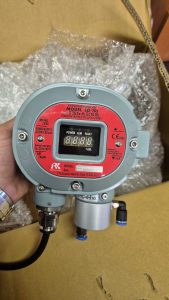
Gas detection response is checked onboard.
The RKI Riken Keiki SD-1RI Fixed Gas Detector is a robust and highly reliable infrared (IR) gas detection solution designed for hazardous and explosive environments. Built with ATEX Ex-proof certification, this detector is ideal for marine vessels, offshore units, engine rooms, pump rooms, and industrial process areas where continuous gas monitoring is critical.
Using infrared absorption technology, the SD-1RI delivers stable and accurate detection of combustible gases without sensor poisoning, ensuring long-term performance and minimal drift. Its solid construction allows it to withstand vibration, humidity, salt air, and temperature variations commonly found onboard ships and in coastal installations.
Manufacturer insight:
RKI Riken Keiki highlights that the SD-1RI is engineered for dependable, long-term operation in harsh environments while maintaining consistent accuracy. The infrared sensing principle also allows reliable detection even in oxygen-deficient atmospheres, making it especially suitable for enclosed marine spaces.
Functional description:
The SD-1RI continuously measures gas concentration and outputs stable signals to control and alarm systems. Its explosion-proof housing ensures safe installation in Zone 1 hazardous areas, while the IR sensor design significantly reduces maintenance frequency.
Services Scope
We provide full onboard support, including: Health Check, Full Function Test, Calibration & Certification, Repair, Commissioning Service
Service Coverage
Spain, Gibraltar, Bulgaria, Turkey, Romania, Netherlands, France, Germany, Italy, Portugal, Greece, Malta, Cyprus, and major ports including Algeciras, Barcelona, Marseille, Rotterdam, Hamburg, Genoa, Piraeus, Istanbul, Valletta, Limassol, and many more across Europe and the Mediterranean.
Regulatory Compliance
Under IMO ISM Code, SOLAS, SIRE 2.0, and OCIMF GVP guidelines, gas detection systems must be regularly tested, calibrated, and maintained to ensure accuracy and safety. Calibration is typically required at intervals recommended by the manufacturer, commonly every 6 to 12 months, and must be recorded as part of the vessel’s Safety Management System (SMS).