

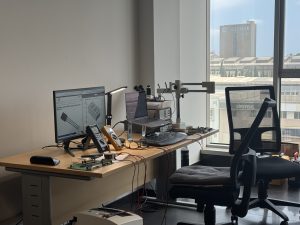
Precision PCB repair and testing for marine electronic systems restoring stability, performance, and long-term reliability.
Electronic systems are critical for safe and efficient vessel operation. Our latest board level repair project focused on restoring full functionality and long-term stability across multiple PCBs used in a marine electronic control unit.
The power supply PCB was repaired by replacing a faulty DC/DC converter that previously failed under a 0.3A load. After repair, the board was tested and confirmed stable while supporting loads up to 0.8A. The newly installed DC/DC converter is rated for up to 2A, providing significant operational headroom and improved reliability for future service conditions.
The digital input/output PCB underwent a complete capacitor replacement to address age-related degradation. Post-repair testing confirmed stable load handling and correct logic behavior across all channels. This preventative upgrade ensures consistent signal processing and extends the operational lifespan of the board under normal working conditions.
The CPU PCB was also repaired with a full capacitor replacement to improve system stability. Testing verified reliable performance; however, correct operation depends on installing the original EEPROM chips from the vessel’s unit. Using non-original EEPROMs can result in address conflicts, communication errors, or complete system malfunction.
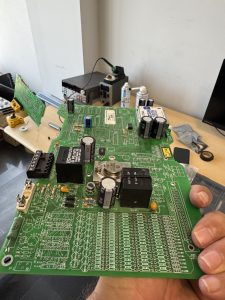
Precision Power Supply PCB repair and testing for marine electronic systems restoring stability, performance, and long-term reliability.
We provide calibration, repair, and commissioning services on board, supporting vessels across Spain, Gibraltar, Bulgaria, Turkey, Romania, the Netherlands, France, Germany, and Italy, including major ports such as Rotterdam, Hamburg, Marseille, Genoa, Barcelona, Istanbul, Piraeus, Antwerp, Lisbon, and Valletta.
Compliance & Calibration
Under IMO SOLAS, ISM Code, SIRE 2.0, and GVP marine inspection requirements, electronic safety and control equipment must be maintained in calibrated and fully operational condition. Calibration and functional verification are typically required annually or as per manufacturer recommendation, and always after repair or component replacement.
Precision repairs today prevent failures tomorrow and keep vessels compliant, safe, and operational.